
Reducing coating gloss while preserving clarity, preventing plastic films from sticking together, and improving ink absorption on paper involve different performance goals. Yet each depends, in part, on how particles and pore structures interact with the surrounding material.
Micronized silica gel is a porous, synthetic amorphous silicon dioxide. By controlling particle size, pore structure and surface properties, manufacturers can develop grades for matting, anti-blocking, adsorption and carrier applications.
For formulators, choosing the right grade starts with understanding how these properties affect the finished product.
How Micronized Silica Is Made
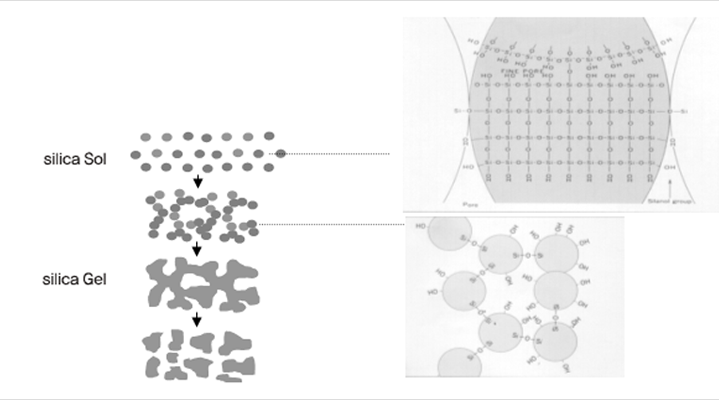
Silica gel can be produced by reacting sodium silicate with an acid. During gel formation, silanol groups condense to form a three-dimensional network linked by silicon–oxygen bonds. Washing, drying, milling and classification then produce powders with different physical characteristics.
These processing steps influence more than particle size. They also affect pore volume, surface area, moisture content and adsorption capacity. Selected grades may receive surface treatment to improve compatibility with particular formulations.
As a result, products described as micronized silica can perform differently. Grade selection should account for particle characteristics, surface properties and processing conditions together.
Matting Agents for Coatings and Inks

Micronized silica is used to reduce gloss in coatings and inks. Appropriately selected particles create fine surface texture that changes how light reflects from the dried coating.
Effective matting requires a balance between gloss reduction and other properties, including clarity, surface feel and storage stability. A grade that performs well in one resin system may behave differently in another. Film thickness and dosage also influence the result.
When evaluating a silica matting agent, consider:
Whether the target gloss can be achieved consistently.
Whether clear coatings develop visible haze.
Whether the surface remains uniform and smooth.
How the additive affects viscosity and application.
Whether settling occurs during storage and how easily the material can be redispersed.
Dispersion conditions also matter. Equipment, mixing time and shear should be established through testing. Longer or more intensive dispersion does not necessarily produce better matting, particularly if it changes the particle structure.
Anti-Blocking Agents for Plastic Films
Plastic films can adhere to adjacent layers during winding, storage and downstream processing. This blocking can interfere with unwinding, bag opening and packaging operations.
Silica anti-blocking agents create microscopic surface projections that reduce effective contact between film layers, helping them separate more readily.
Suitable grades can be used in polyethylene, polypropylene and other film systems. Performance depends on the polymer, film structure, additive package and processing conditions.
Selection should balance anti-blocking performance with:
Film clarity and haze.
Dispersion quality and visible defects.
Particle size relative to film thickness.
Dosage and processing requirements.
Interactions with other additives.
For transparent packaging films, testing under representative production conditions is essential to establish the right balance between film separation and optical performance.
Functional Additives for Paper and Printing Coatings
The porous structure of micronized silica can help control absorption and surface properties in paper coatings.
In inkjet coatings, an appropriate pore structure supports liquid uptake and helps control ink spreading. This can contribute to sharper text and better-defined image details. Final print quality also depends on the ink, binder, coating weight and drying conditions.
In thermal paper, selected silica grades may be incorporated into undercoats or other functional layers to support absorption, image development or processing performance. Each coating layer has a different role and should be evaluated accordingly.
Paper applications require more than high adsorption capacity. Coating viscosity, coating strength, surface uniformity and actual printing results should all form part of the evaluation.
Adsorption and Carrier Applications
Porous silica can also act as a carrier for selected liquid ingredients, helping convert them into powders that are easier to meter, blend and disperse.
For these applications, key considerations include ingredient compatibility, loading capacity, powder flow and storage stability.
Specialized silica grades are also used in adsorption processes such as beverage treatment. Their selection criteria differ from those of general-purpose industrial matting agents.
Food, feed, oral-care and pharmaceutical applications require grades suitable for the intended use and destination market. Relevant technical and compliance documentation should be confirmed for the specific product.
How to Select the Right Micronized Silica
Start with the application challenge: reducing gloss, improving film opening or increasing coating absorption. Then define the formulation, processing conditions and performance targets before comparing grades.
The following properties provide a useful starting point:
Property | Selection Considerations |
Particle size and distribution | Compatibility with film thickness, surface requirements and processing conditions |
Pore volume and surface area | Suitability for the required adsorption or carrier function |
Oil absorption | Potential effects on dosage, viscosity and processing |
Moisture content | Compatibility with the formulation’s moisture requirements |
Surface treatment | Compatibility with resins, solvents or polymers |
Batch consistency | Ability to maintain predictable performance in production |
Laboratory screening should be followed by pilot or production trials to confirm dosage, dispersion conditions and finished-product performance.
Micronized Silica Solutions from SINCHEM
SINCHEM offers micronized silica products for applications including coatings, inks, plastic films and printing adsorption media. Our team supports product selection and technical documentation review based on customers’ application requirements.
Whether you are developing a matte coating, improving film anti-blocking performance or evaluating an adsorptive material for paper coatings, share your formulation, processing conditions, target properties and estimated demand with us.
Contact SINCHEM at info@sinchem.net to discuss suitable grades for evaluation.